China Top Cash Register Receipt Paper Suppliers?
Choosing the right China Top Cash Register Receipt Paper Suppliers requires more than comparing prices. Product consistency matters at every checkout. A roll should feed smoothly, print clearly, and resist fading during storage. Cash Register Receipt Paper must also match the printer model, core size, roll width, and operating environment.
Reliable suppliers usually provide thermal paper, bond paper, custom-printed rolls, and different packaging options. Experienced buyers should request samples before placing large orders. Check the paper surface, winding tension, roll length, and print darkness. Small defects can create frequent jams and slow busy retail counters. Supplier experience with overseas shipments also deserves attention. Clear communication, stable production capacity, and traceable quality records build confidence.
Certifications matter.
However, no supplier ranking remains perfect for every buyer. A factory with excellent export experience may not offer the lowest price. Another supplier may provide competitive costs but weaker quality control. This difference deserves careful review. Buyers should examine factory audits, testing reports, customer feedback, and response times. Questions about restricted chemical content, recyclable packaging, and responsible sourcing should receive direct answers. Specifications must appear on quotations and purchase agreements. Otherwise, misunderstandings can arise after production begins.
This guide introduces leading Chinese suppliers through practical evaluation criteria. It focuses on manufacturing capability, paper quality, customization, delivery reliability, and customer support. The goal is not to promote one universal choice. It is to help retailers, wholesalers, and distributors identify a dependable match for their equipment and market needs. A careful sample review often reveals more than an attractive catalog.
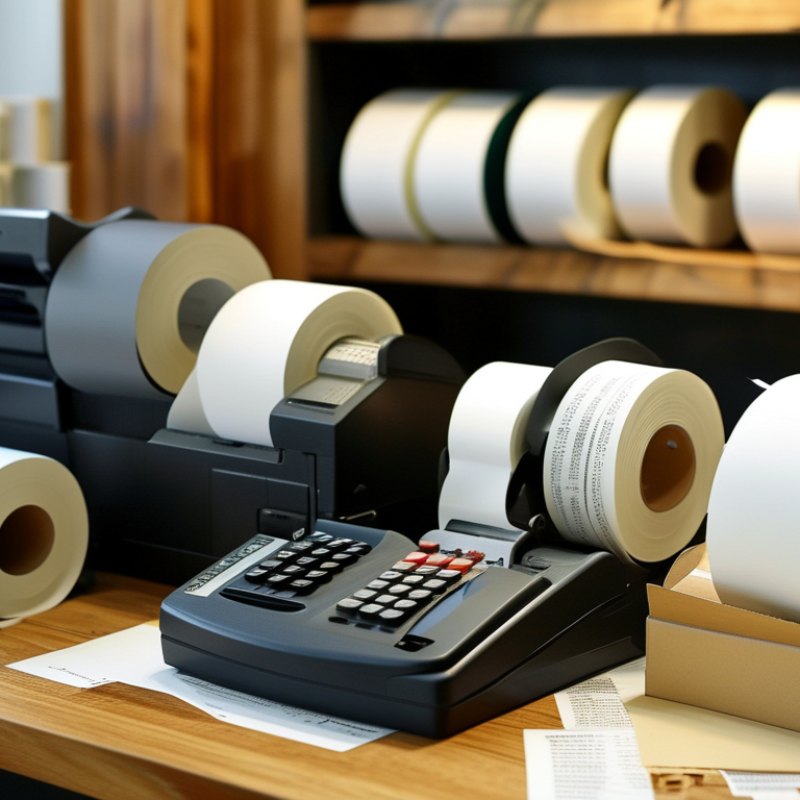
China’s Cash Register Receipt Paper Market: 80 mm Width and 48–55 GSM
China Top Cash Register Receipt Paper Suppliers?
China’s cash register receipt paper market commonly centers on 80 mm rolls. This width fits many supermarket, restaurant, and self-service POS terminals. The usual paper weight ranges from 48 to 55 GSM. Lower GSM reduces shipping volume, but it can feel thinner during handling.
Industry reports support this market direction. Smithers’ thermal paper research identifies retail, logistics, and banking as major demand sectors. Grand View Research also reports continued growth in the global thermal paper market, driven by transaction printing and compact POS equipment. These reports do not make every Chinese supplier reliable. Factory audits still matter. In practice, buyers should check coating uniformity, roll length, core size, and print darkness. A sample may perform well, yet production batches can vary. That uncomfortable detail deserves attention.
Tips: Request 80 mm × 80 mm and 80 mm × 60 mm samples before ordering. Confirm 48, 50, or 55 GSM with a measurable specification. Test rolls in real printers for cutting, curling, dust, and image fading. Ask for recent GSM inspection records and thermal-image retention data. Suppliers with stable export experience should explain their coating process, packaging controls, and moisture protection clearly. “BPA-free” claims also need supporting test documentation, not only a sales statement.
Thermal Receipt Paper Standards: BPA, BPS, FSC, and ISO 9001 Compliance
China Top Cash Register Receipt Paper Suppliers?
Thermal receipt paper compliance starts with chemistry, not appearance. EU Regulation 2016/2235 restricts BPA in thermal paper to below 0.02% by weight. The European Chemicals Agency also warns that replacing BPA with BPS does not automatically prove lower risk. Buyers should request recent laboratory reports, not only supplier declarations. BPS-free paper deserves the same scrutiny.
FSC certification addresses responsible forest sourcing and traceability. A valid FSC claim should include a certificate code and Chain of Custody verification. This matters when paper rolls pass through several converters before shipment. The FSC Facts and Figures report lists more than 160 million hectares of certified forests worldwide, showing the scale of the system. Still, a logo alone is weak evidence.
ISO 9001 focuses on quality management, not chemical safety. The ISO Survey 2023 recorded more than one million ISO 9001 certificates globally. For receipt paper suppliers, certification should connect with roll-width checks, coating consistency, core strength, and batch records. In factory audits, I would also inspect packaging labels and retained samples. Small errors happen. A supplier may meet BPA limits yet provide inconsistent printing performance. That gap needs reflection. Request test dates, accredited laboratory details, FSC scope, and corrective-action records before approving a supplier.
Leading Chinese Receipt Paper Suppliers: Products, Certifications, and Markets
China’s receipt paper suppliers serve a market shaped by thermal printing, retail expansion, and stricter chemical controls. Grand View Research estimates that the global thermal paper market will grow at about 6% annually through 2030. Smithers also identifies retail, transport, healthcare, and banking as major demand sectors. Chinese factories commonly produce thermal rolls, bond paper, carbonless rolls, kitchen order rolls, and custom-sized POS paper.
Product quality depends on more than paper brightness. A reliable supplier should provide stable thermal sensitivity, clean cutting, tight winding, and consistent core dimensions. During sample checks, buyers should print small receipts, rub the surface, and store rolls in warm conditions. Fading can appear later. That is the uncomfortable part. A smooth sample may hide weak coating performance.
Certifications help, but they require verification. Common documents include ISO 9001, FSC chain-of-custody certification, REACH compliance, RoHS testing, and BPA or BPS-free declarations. Buyers should request recent laboratory reports, not only factory certificates. Export suppliers serve Europe, North America, Southeast Asia, the Middle East, and Latin America. Market access often depends on labeling, packaging, pallet strength, and moisture protection. A 57-millimeter roll needs accurate width control; even a small deviation can cause printer jams. Supplier audits should examine coating equipment, warehouse humidity, traceability records, and complaint handling. Some factories communicate well before payment, then respond slowly after delivery. That risk deserves attention.
China Receipt Paper Supplier Landscape: Common Product Formats
The chart compares widely used thermal receipt roll widths supplied for POS terminals, ATMs, kiosks, weighing scales, and self-service machines. The 57–58 mm formats are common in compact terminals, while 76–82 mm formats are widely used for retail and banking receipts. Buyers commonly evaluate suppliers by thermal coating quality, BPA/BPS-free options, FSC or recycled-content availability, ISO 9001 quality systems, ISO 14001 environmental systems, and compliance with applicable REACH requirements. Typical export markets include retail, hospitality, transportation, banking, logistics, and public-service equipment.
Supplier Selection Guide: Comparing Prices, Lead Times, and Quality Metrics
China Top Cash Register Receipt Paper Suppliers?
Selecting a receipt paper supplier requires more than comparing the lowest quotation. Request prices by roll, carton, and square meter. A cheap roll may contain less paper or use a smaller core. Check roll length, paper width, core diameter, and packing weight. Ask for a clear quotation with tooling, delivery, and export charges included.
Lead time should be measured from artwork approval to warehouse dispatch. For regular orders, many suppliers can provide production schedules and shipment updates. Confirm sample timing, production capacity, and backup material sources. A seven-day promise means little without written milestones. I once accepted a short lead time, but the shipment slipped because coating materials arrived late. That mistake changed how I assess delivery reliability.
Quality needs measurable checks. Compare GSM tolerance, roll length accuracy, thermal image density, print darkness, and fading after heat exposure. Test samples in your actual printers, not only in a supplier’s machine. Store a few rolls in warm and humid conditions. Watch for paper dust, curling, uneven winding, and adhesive residue. Request safety declarations and current test reports for the intended market. Certifications help, but they do not replace independent sampling. The lowest price still looks attractive. It may not remain attractive after jams, returns, and wasted labor.