


ProMach is your partner from start to finish. Our product brands are grouped into distinct business lines that make the most sense to our customers, covering every function of the production line: Filling, Bottling & Capping, Decorative Labeling, Flexibles & Trays, Pharma, Handling & Sterilizing, Labeling & Coding, Robotics & End of Line, and Systems & Integration.
learn moreChoosing the right barcode printer labels can keep orders moving and inventory records dependable. The best option depends on the printer, surface, environment, and expected label life. A small café may need affordable paper labels for takeaway containers. A warehouse may need durable synthetic labels that remain readable after handling. Details matter.
GS1, the global standards organization for identification systems, describes its role with the phrase, “The global language of business.” That idea matters at the label level, too: a barcode must print clearly and scan reliably wherever products move. A label that looks fine on a desk can fail on a cold carton or a dusty shelf. Small test runs help reveal those problems before a full purchase.
This guide compares barcode printer labels for different business needs, including direct thermal and thermal transfer options, common materials, adhesives, and use cases. It also considers printer compatibility, label size, and operating conditions. No single label suits every job. And specifications do not tell the whole story. A supplier’s sample roll may behave differently on your packaging, so test it in real conditions before committing. The aim is practical: help you choose labels that fit your workflow, budget, and scanning needs without overbuying or overlooking a small but costly detail.
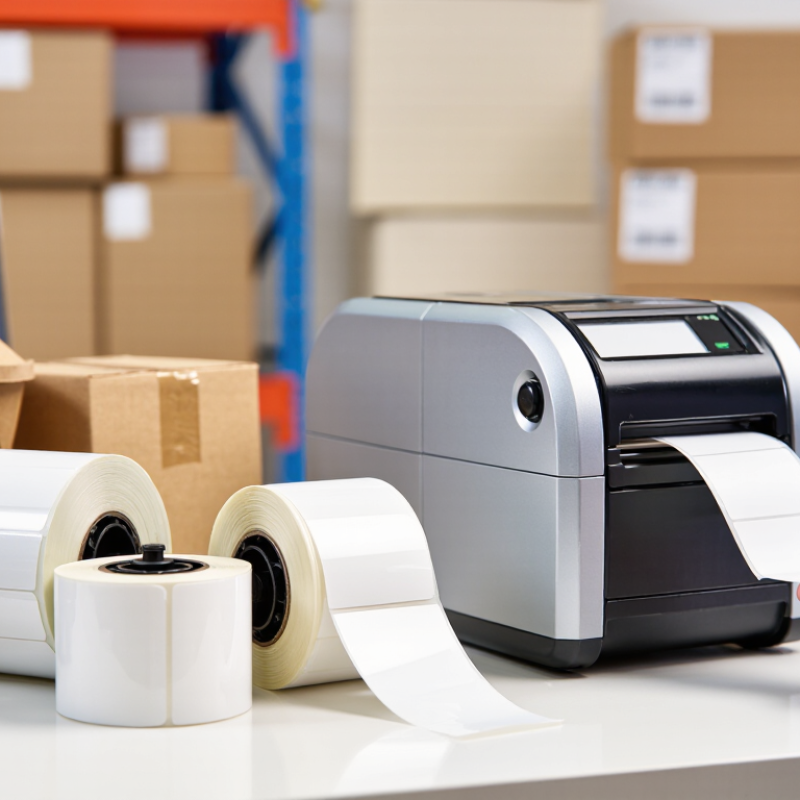
Barcode printer labels pair a printed barcode with a face material, adhesive, and printing method. Direct thermal labels react to heat and need no ribbon. They suit short-lived shipping labels, but heat and sunlight can darken them. Thermal-transfer labels use a ribbon, and the right ribbon-stock combination can improve resistance to moisture, rubbing, or chemicals. It is not automatic; the match matters.
GS1 reports that its standards support more than 10 billion scans each day across over two million companies (GS1, “About GS1”). That scale makes legible, durable labels a practical concern, not just a printer setting.
Paper labels are economical for cartons and indoor inventory. Synthetic films, such as polypropylene or polyester, are better suited to damp, cold, or frequently handled items. Permanent adhesive helps labels stay put on bins; removable adhesive can reduce residue on reusable containers.
Small detail. Big consequence.
Check the full label path before ordering: surface texture, temperature, exposure, and how long the barcode must remain readable. A label that scans perfectly in a warm office may fail on a chilled tote. I would test a small batch under real storage and handling conditions; specifications alone can be reassuring, but incomplete.
Choosing barcode labels starts with the surface they must survive. Paper labels suit dry indoor shelves and routine shipping, while synthetic films resist moisture, abrasion, and handling better. A chilled package may need a different face material from a cardboard carton. Small details matter. Test labels on the actual packaging, especially if it is dusty, curved, or cold. Adhesives vary too: removable options help with reusable bins, while stronger permanent adhesives suit long-term identification. Yet “permanent” does not guarantee a clean bond on every surface.
Match label size to both the barcode and the available print area. A compact label can fit a narrow product, but cramped bars may scan poorly if the code is reduced too far. Leave clear space around the barcode, and verify readability with the scanners used at work.
Print technology affects material choice: direct thermal printing needs no ribbon but can fade with heat, sunlight, or time. Thermal transfer printing uses a ribbon and can produce more durable marks on compatible stock. Check printer settings, core size, and roll direction before ordering.
There is no universal best label; a short trial run often reveals problems that a specification sheet misses. I would test more than one adhesive, even when the first sample looks fine.
Barcode labels should match the surface, temperature, and handling they will face. A chilled-food room needs moisture-resistant stock and adhesive that stays bonded on damp packaging. For short-life indoor tags, direct-thermal labels can avoid ribbon changes. But heat and sunlight may darken them over time. Thermal-transfer labels usually suit longer storage or rougher handling, provided the ribbon and face stock are compatible.
Test the actual package, not just a sample sheet. Press a label onto a cold carton, then scan it after condensation forms. Check that the barcode’s quiet zones remain clear and its edges do not lift. Small details matter. A label that prints sharply at the bench can fail on a curved bottle or dusty tote. I would also retest after changing suppliers; this step is easy to skip.
The 2024 MHI Annual Industry Report found that 55% of surveyed supply-chain professionals planned to increase technology and innovation investment. That shift makes dependable identification more important, but it does not mean every operation needs premium labels. Match adhesive strength, face material, and print method to actual conditions. For example, a returnable warehouse tote needs abrasion resistance; a shipping carton may only need a readable label through transit. Leave room for testing. Conditions vary more than specification sheets suggest.
Compare common label constructions by application, printing method, and working environment. Actual performance depends on the specific label stock, adhesive, printer settings, and exposure conditions.
| Business Need | Recommended Label Type | Typical Print Method | Suitable Environments | Key Advantages | Important Considerations |
|---|---|---|---|---|---|
| Short-term shipping and parcel identification | Coated or uncoated direct thermal paper | Direct thermal | Indoor shipping areas and short-duration transit | No ribbon is required; straightforward printing for frequently replaced labels. | Heat, sunlight, abrasion, and some chemicals can darken or fade the image. Not ideal when labels must remain readable for long periods. |
| General inventory, cartons, and warehouse locations | Thermal-transfer paper | Thermal transfer with a compatible ribbon | Dry indoor storage and routine handling | Typically offers more durable printed images than direct thermal paper and supports a wide range of label sizes. | Choose the ribbon and adhesive to suit the label surface and expected handling. Paper can tear or degrade when exposed to moisture. |
| Retail shelves, product packaging, and curved containers | White polypropylene film | Thermal transfer; some printer-compatible constructions may support other methods | Retail and light-duty indoor use; some formulations tolerate occasional moisture | Flexible, tear-resistant, and often better suited to curved surfaces than paper. | Check the specific product’s resistance to water, oils, abrasion, and cleaning agents. Use a compatible ribbon where required. |
| Equipment identification and long-life asset tracking | Polyester film | Thermal transfer with a compatible resin ribbon | Applications requiring greater resistance to handling, moisture, or outdoor exposure | Durable film construction can maintain label integrity longer than ordinary paper in demanding applications. | Performance varies by construction. Confirm resistance to temperature, chemicals, UV exposure, and the actual surface before ordering. |
| Freezer, chilled-food, and cold-storage labeling | Cold-temperature label stock with freezer-grade adhesive | Direct thermal or thermal transfer, as specified for the stock | Refrigerated or frozen storage when the label is designed for those conditions | Specialized adhesive formulations can help labels bond to cold surfaces or remain attached during cold storage. | Verify application temperature, service temperature, and whether the surface may be wet or frosted. Standard adhesives may not bond reliably in these conditions. |
| Reusable containers, bins, or temporary process tracking | Removable-adhesive paper or film label | Thermal transfer or direct thermal, depending on the label construction | Indoor workflows where labels need to be removed after use | Designed for removal from suitable surfaces with less adhesive residue than permanent labels. | Removability depends on dwell time, surface material, temperature, and cleanliness. Test before using on valuable or delicate surfaces. |
| Product integrity and package-opening detection | Tamper-evident label stock | Usually thermal transfer; confirm printer and ribbon compatibility | Sealed packaging and controlled distribution workflows | Some constructions are designed to show evidence of removal or interfere with clean label transfer. | Features vary by product and surface. A tamper-evident label is not a substitute for a security seal or validated packaging system. |
| High-volume labeling with frequent stock changes | Standardized paper or film labels selected for the workflow | Direct thermal for short-life labels; thermal transfer for longer-life needs | Distribution centers, production lines, and back-of-house operations | Matching core size, roll dimensions, gap or mark sensing, and label dimensions can reduce printer setup issues. | Confirm printer media specifications, sensor type, maximum roll diameter, and barcode size before purchasing. Test scan readability on the finished label. |
Selection tip: Match the face material, adhesive, and printing method to the label’s surface, expected life, and exposure. Keep a clear, high-contrast barcode area and validate printed samples with the scanners used in your operation.
A barcode label is only useful when the printer can feed it consistently and the scanner can read it. Check the printer’s supported label width, roll-core size, sensor type, and print method before comparing prices. Direct thermal labels need no ribbon, but heat and sunlight can fade them. Thermal-transfer labels use a ribbon and may suit longer storage or rough handling. Test a small batch first. It is a modest step, but easy to skip when a shipment is urgent.
Durability depends on the setting, not just the label description. A warehouse shelf may need a different adhesive from a chilled package or a frequently handled return bin. Look for labels that resist expected moisture, abrasion, and temperature changes, then scan samples after exposure. Total cost includes more than each roll: ribbons, wasted labels, reprints, and staff time all count. A low-cost label that peels off can become expensive. I would not assume one material fits every workflow; real conditions are messier than a product chart. Compare the cost per reliably readable label, and note where your estimate still relies on guesswork.
A reliable barcode label begins with its surface and surroundings. Start with the surface. Paper labels work well for many dry, indoor uses, while synthetic stock can better resist moisture and abrasion. Check that the label width, roll core, and adhesive suit your printer and the item being labeled. A carton, chilled container, and curved bottle may need different materials. Store rolls in a cool, dry place, away from direct sunlight. Heat and dust can affect print quality.
Test samples on real products, not just a flat desk. Print several labels, then scan them at normal working distance under warehouse or checkout lighting. Try more than one scanner if possible. Look for faded bars, smudges, wrinkles, and edges that lift after handling. A successful scan once is not enough. Test again after labels have been rubbed, chilled, or exposed to ordinary workplace conditions. Results can vary between batches, so record the stock, printer settings, and test conditions.
This takes time.
During routine care, clean the printhead and sensors as directed in the printer manual. Change print darkness or speed in small steps, then check another sample. Excess heat may darken bars but blur narrow spaces. Inspect stored rolls before use, especially after long storage. Even a careful process can miss a failure, so review scan errors and revise the test when products, packaging, or conditions change.